We utilise single electron spins associated to a defect in diamond, the nitrogen-vacancy (NV) centre, and similar systems in other materials (SiC) and engineered proteins, as tiny nanoscale quantum sensors, and apply them to investigate interesting problems in condensed matter physics, biology and medicine. We operate and manage the Heriot-Watt’s “Nanoscale quantum sensing facility”, hosting the world’s first commercial low-temperature scanning quantum sensor, and we deploy it to study magnetism, spin waves, superconductivity in 2D van der Waals materials and their heterostructures. As part of the UK “Quantum sensing hub for biomedical research”, we deploy spin-based quantum sensors to detect small quantities of molecules relevant for health-care, with the goal of enabling novel biomedical research tools and early disease detection. Our healthcare research is carried out in the BSL-2 “Quantum Bio-Imaging Laboratory”, equipped with several unique, in-house-developed multimodal quantum sensing microscopes and an integrated cell culture facility.
The operation of our quantum sensors is enhanced by AI and machine learning techniques, which make their operation fast, automated and robust, as required by deployment in different fields.

Quantum sensing of complex quantum materials. One of our major efforts is to directly image currents and magnetic fields generated by spin and charge transport in quantum materials. Doing so enables a unique window into the world of condensed matter physics in which collective electron and spin excitations are both fundamentally interesting and technologically applicable. For example, many quantum materials derive their properties from reduction of dimensionality, which has shown electron confinement and increased interactions in two dimensions. Such discoveries at the interface of semiconductors has enabled high-mobility field effect transistors. Our research focuses on exploring coupling spin/magnetic order in novel magnetic thin films and ‘van der Waals’ heterostructures (see Link) including magnetic textures, spin waves, and Moiré superlattices. To do we we have recently set-up a Nanoscale Quantum Sensing facility, including the first commercial scanning spin-based quantum sensor operating between 1.8-300K.
Quantum sensing in biochemistry and Healthcare. We are developing quantum sensing technologies to probe biochemical and biological processes with unprecedented sensitivity and spatio-temporal resolution. Our work aims to bridge quantum science, chemistry, and biology, creating innovative tools to study fundamental biological mechanisms and develop next-generation diagnostic approaches for healthcare.
Our research focuses on spin-based quantum sensors, including:
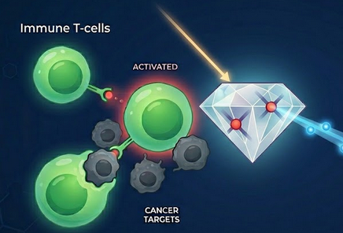
probing intracellular metabolism, using nitrogen-vacancy (NV) centres in nanodiamonds and protein qubits. We are particularly interested in metabolic heterogeneity within the immune system and the metabolic shifts that occur during interactions between immune cells and their surrounding environment. These studies include cellular responses to materials, such as nanoparticles and implant materials, as well as interactions with other cell types, including cancer cells. Using a multimodal quantum sensing approach, we monitor a range of metabolic markers. These include mitochondrial free radicals (ROS/RNS) and paramagnetic ions, which can serve as early indicators of metabolic changes in cells. If this research interests you, please explore selected publications for further information (Acta Biomaterialia; Accounts of Chemical Research).
pushing magnetic resonance to the nanoscale, to enable highly sensitive detection and structural analysis of molecules at surfaces and interfaces, with applications in biochemistry, catalysis, and diagnostics. If you are interested in this field, you can explore the Roadmap on Nanoscale Magnetic Resonance Imaging, which we co-authored with leading international researchers. This roadmap highlights emerging opportunities and key challenges in nanoscale magnetic resonance.
developing novel quantum sensors in silicon carbide (SiC), a mature semiconductor platform fully compatible with standard industrial CMOS processing, as a scalable platform for bio-compatible sensing and disease detection technologies.
We are working on these topics as part of the “UK Quantum Hub for Biomedical Research” (Q-BIOMED).
Learning Quantum Learning - We are developing quantum sensing tools by adding self-optimising algorithms that adapt measurement settings in real time, cutting down the long data acquisition times. See more: Link
 Quantum Photonics Laboratory @ Heriot-Watt University